

Latest News
Find our archive of news distributions below. To request a media interview or statement from one of our members, visit our press inquiries page here.
Search Our Press Release Archive
Sort by Rep. or Topic
- Economy
- Education
- IBLC
- Internship
- Leadership
- Mental Health
- Public Safety
- Rep. Alex Burton
- Rep. Blake Johnson
- Rep. Carey Hamilton
- Rep. Carolyn Jackson
- Rep. Cherrish Pryor
- Rep. Chris Campbell
- Rep. Chuck Moseley
- Rep. Dant Chesser
- Rep. Earl Harris Jr.
- Rep. Ed DeLaney
- Rep. Gregory W. Porter
- Rep. John Bartlett
- Rep. Justin Moed
- Rep. Kyle Miller
- Rep. Matt Pierce
- Rep. Maureen Bauer
- Rep. Mike Andrade
- Rep. Mitch Gore
- Rep. Pat Boy
- Rep. Phil GiaQuinta
- Rep. Ragen Hatcher
- Rep. Randy Novak
- Rep. Renee Pack
- Rep. Robin Shackleford
- Rep. Ryan Dvorak
- Rep. Sheila Klinker
- Rep. Sue Errington
- Rep. Tonya Pfaff
- Rep. Vanessa Summers
- Rep. Vernon Smith
- Rep. Victoria Garcia Wilburn
- Rep. Wendy Dant Chesser
- cherrish

Boy’s amended opioid overdose reversal bill passes out of House Education Committee
Today, Feb. 12, State Rep. Pat Boy’s (D-Michigan City) House Bill 1376 passed unanimously out of the House Education Committee. The original version of the bill, which aimed to supply opioid overdose reversal medication in schools across the state, has been significantly altered. The amended bill now only includes a redefinition of “naloxone” in the Indiana Code, defining it as “a federal Food and Drug Administration-approved opioid overdose reversal medication, including nasal spray.
Today, Feb. 12, State Rep. Pat Boy’s (D-Michigan City) House Bill 1376 passed unanimously out of the House Education Committee. The original version of the bill, which aimed to supply opioid overdose reversal medication in schools across the state, has been significantly altered. The amended bill now only includes a redefinition of “naloxone” in the Indiana Code, defining it as “a federal Food and Drug Administration-approved opioid overdose reversal medication, including nasal spray.
Boy released the following statement on the amended bill’s passage:
“While today’s amendments alter the original intent of the bill, I recognize that this change may open the door to more conversations about the opioid crisis and how we can address it in our schools and communities. The redefinition of naloxone is a small, but important step in acknowledging the need for better resources to combat opioid overdoses. However, we cannot stop here. This is not enough to protect the lives of our young people. We are facing an epidemic, and the urgency to act has never been greater.
“The statistics speak for themselves: The National Institute on Drug Abuse, in a report from May 2024, revealed that law enforcement seized 2,300 times more fentanyl pills in 2023 than in 2017—115,562,603 pills compared to 49,657. This surge in fentanyl distribution is putting our youth at an unprecedented risk. According to the American Medical Association in 2023, the conversation has grown louder—it's time to put opioid overdose reversal medication in schools, where it can save lives.
“We owe it to our youth to take immediate and decisive action. We cannot afford to wait. We must work together to create a safe environment for our students, one where they have the resources to stay alive and thrive. Today’s amendments are a start, but we cannot stop here. I am committed to pushing for stronger legislation that will address this public health crisis and protect future generations.”
HB 1376 will now move to the House floor for further consideration.

Smith bill to increase reporting for incidents of bullying passes in Education Committee
Today, Feb. 12, House Bill 1539, authored by State Rep. Vernon G. Smith (D-Gary), passed the House Education Committee. The bill expands the definition of bullying to include severe, one-time acts, not just repeated offenses. It also requires school corporations to report incidents of bullying no later than one business day to the parents of the alleged perpetrator and targeted student. HB 1539 also updates the legal language for students who transfer schools.
Today, Feb. 12, House Bill 1539, authored by State Rep. Vernon G. Smith (D-Gary), passed the House Education Committee. The bill expands the definition of bullying to include severe, one-time acts, not just repeated offenses. It also requires school corporations to report incidents of bullying no later than one business day to the parents of the alleged perpetrator and targeted student. HB 1539 also updates the legal language for students who transfer schools.
Smith released the following statement about the committee's passage of his bill:
“Education is an essential part of childhood, and we want our schools to be a safe haven. Sometimes coming to school is the only way a student gets a hot meal, chats with a positive adult influence or sees their cherished friends. Our children deserve to be safe in the school building.
“Current law allows schools to report no later than five business days, but this is far too long. Parents deserve to know about a bullying incident as soon as possible. In some cases, it’s the difference between life and death. Students who experience bullying have an increased risk for depression and anxiety. I want our students to believe in the system of reporting. I want them to know that if they speak up things will get better for them. I believe my bill protects our students and ensures their voices are heard and respected.
“I think as it moves forward, we need to continue to discuss cyber-bullying and protections for our children online. I’m grateful that this bill passed in the House Education Committee, and I look forward to its vote on the House floor.”

Summers’ trauma-informed care bill passes out of committee
Today, Feb. 12, House Bill 1241, authored by State Rep. Vanessa Summers (D-Indianapolis), passed unanimously out of the House Committee on Family, Children and Human Affairs.
Today, Feb. 12, House Bill 1241, authored by State Rep. Vanessa Summers (D-Indianapolis), passed unanimously out of the House Committee on Family, Children and Human Affairs.
This legislation would establish a Trauma Informed Care Commission to study and provide recommendations for best practices to care for children and families who have undergone trauma.
Summers issued the following statement after the bill passed out of committee:
"From gun violence to poverty to discrimination, there's an unfortunate number of Hoosiers who have faced trauma in their lives. This bill aims to assist health care providers, social workers, teachers and other professionals to assist those in need to the best of their ability. I look forward to discussing this work further."

Jackson’s amendment to expand voting rights for Indiana seniors blocked by House Republicans
Today, Feb. 11, Rep. Carolyn Jackson (D- Hammond) introduced two critical amendments aimed at breaking down barriers and improving access for voters. These amendments focus on two key areas: permanent absentee voter status for elderly and disabled voters and preserving school district's ability to hold referenda on local funding with restrictions from the state.
Today, Feb. 11, Rep. Carolyn Jackson (D- Hammond) introduced two critical amendments aimed at breaking down barriers and improving access for voters. These amendments focus on two key areas: permanent absentee voter status for elderly and disabled voters and preserving school district's ability to hold referenda on local funding with restrictions from the state.
"Indiana consistently ranks among the lowest states in voter turnout," Jackson said. "Unnecessary barriers like repetitive absentee ballot applications only make it harder for people to participate in our democracy. This amendment would've been a simple fix that removes red tape and ensures that seniors and Hoosiers with disabilities can vote without unnecessary hurdles."
Currently, Indiana allows elderly and disabled voters to cast absentee ballots by mail, but they must submit an application for every election cycle. Jackson's first amendment speeds up this process, eliminating the repetitive paperwork and making voting more accessible for Indiana's vulnerable populations. The amendment to House Bill 1679 was struck down on procedural grounds.
Jackson also introduced an amendment to HB 1681, which removes restrictions on when schools can hold a funding referendum. The current law gives voters the ability to decide what is best for their own communities, but the new legislation would limit when schools can hold referenda, making it harder for them to secure funding.
"We don't know what school funding will look like in the state budget, but we do know that funding will be tight. Schools need every tool available to ensure they have the budget to operate, providing the best education opportunities for our youth," Jackson added.
Jackson's amendment to HB 1681 was defeated along party lines.

Pryor amendment to expand voting rights struck down by House Republicans
Today, Feb. 11, State Rep. Cherrish Pryor (D-Indianapolis) offered an amendment to allow no excuse absentee vote by mail. This amendment would bring Indiana in line with 28 other states and make voting more accessible for Hoosiers who may not be able to make it to the polls. The amendment was struck down on procedural grounds.
Today, Feb. 11, State Rep. Cherrish Pryor (D-Indianapolis) offered an amendment to allow no excuse absentee vote by mail. This amendment would bring Indiana in line with 28 other states and make voting more accessible for Hoosiers who may not be able to make it to the polls. The amendment was struck down on procedural grounds.
“In a time where voter apathy is growing, this body needs to be taking every action possible to make it easier for Hoosiers to engage in our government and make their voice heard.
“In 2024, only 61% of registered voters cast their ballots, down 6% from the 2020 election. Indiana has one of the lowest voter turnout rates in the nation. In order for government to truly serve the people, we need to ensure that all Hoosiers have access to vote in the way that meets their unique situation.
“We continue to hear from Hoosiers that this body is not reacting to the needs of everyday working Hoosiers. Making it easier for Hoosiers to vote is the most basic and vital step we can take to end voter apathy and ensure responsiveness to the people that elect us to serve.”

DeLaney calls out the Supermajority for not hearing concerns of Hoosier voters
Today, Feb. 11, House Democrats offered several amendments aimed at expanding voting rights for Hoosiers. Instead of allowing a full discussion and vote about strengthening our democracy by making absentee ballots more accessible and allowing citizen-led ballot initiatives, the supermajority struck the amendments down on procedural grounds, stifling discussion.
Today, Feb. 11, House Democrats offered several amendments aimed at expanding voting rights for Hoosiers. Instead of allowing a full discussion and vote about strengthening our democracy by making absentee ballots more accessible and allowing citizen-led ballot initiatives, the supermajority struck the amendments down on procedural grounds, stifling discussion.
State Rep. Ed DeLaney (D-Indianapolis) issued the following statement:
“The Republican supermajority in the House has made it more than clear that they are reluctant to hear what concerns the public. They reject non-binding referenda. They seem to not want to hear how Hoosiers feel on controversial issues such as cannabis legalization or abortion rights. Could this be because they are afraid that their unpopular policies would be rejected by the majority of the voting public?
“We are falling into a practice of using House procedures to dodge difficult votes. As an example, my colleagues in the House filed amendments on House Bill 1679 to make absentee ballots more accessible for Hoosiers, only to be told they didn’t belong in a bill quite literally entitled ‘Various election matters.’ Indiana has historically had one of the lowest voter turnout rates in the nation. The House should be disturbed by that fact. Instead of taking action to make voting more accessible, House Republicans chose to shut down any vote on the House floor.
“My takeaway from today’s events on the floor is that House Republicans want to avoid any vote that is difficult for their members.”

Hamilton bill to boost workforce development, reduce recidivism heading to the Senate
Today, Feb. 11, House Bill 1289, authored by State Rep. Carey Hamilton (D-Indianapolis), unanimously passed on third reading in the House of Representatives. The bill has been sent to the Senate for further consideration.
Today, Feb. 11, House Bill 1289, authored by State Rep. Carey Hamilton (D-Indianapolis), unanimously passed on third reading in the House of Representatives. The bill has been sent to the Senate for further consideration.
HB 1289 defines "employment social enterprises" in Indiana Code to match the federal definition. This would allow the state of Indiana to better compete for federal funding for organizations that provide job training and services to help integrate those who were formerly incarcerated back into society.
Hamilton released the following statement regarding the bill's passage in the House:
"Fully supporting Indiana's economy and workforce requires a collaborative, comprehensive effort," Hamilton said. "People that have recently been released from prison often struggle to secure jobs. Anyone that wants to work and contribute to the economy of our state should have every opportunity available to do so. Employment Social Enterprises give formerly incarcerated individuals a transitional job that provides job skills training as well as a chance to learn valuable life skills that can help them find and keep jobs. Not only would this expand our workforce, but it would also reduce recidivism rates as employment is one of the critical steps to reintegrate formerly incarcerated individuals into society. By simply adjusting the language in Indiana code to match the federal definition, House Bill 1289 would allow these organizations to receive federal funding that is critical to their mission of providing people with second chances and strengthening our economy.
"I appreciate the opportunity to advance this common-sense, bipartisan effort. I look forward to working with my colleagues in the Senate to get this bill passed into law for the benefit of all Hoosiers."

Errington’s amendment on ballot initiatives struck down on House Floor
Today, State Rep. Sue Errington (D-Muncie) introduced an amendment to House Bill 1681 to expand the use of ballot initiatives in Indiana. The proposed amendment would allow nonbinding ballot initiatives, enabling voters to weigh in on important issues without changing the law or the constitution. Although these initiatives would not have the force of law, they would send a clear message to lawmakers, urging them to consider public sentiment when crafting policies.
Today, State Rep. Sue Errington (D-Muncie) introduced an amendment to House Bill 1681 to expand the use of ballot initiatives in Indiana. The proposed amendment would allow nonbinding ballot initiatives, enabling voters to weigh in on important issues without changing the law or the constitution. Although these initiatives would not have the force of law, they would send a clear message to lawmakers, urging them to consider public sentiment when crafting policies.
Despite the amendment’s expected resistance, it highlights Errington’s ongoing commitment to empowering citizens and ensuring their voices are heard on key issues.
Errington released the following statement on the amendment:
“Across the country, we’ve seen the power of ballot initiatives, giving citizens a direct say on critical issues affecting their lives. By allowing Hoosiers to vote on nonbinding initiatives, we are providing them with an opportunity to express their views, particularly on topics that this legislature may not be addressing despite public support. Whether it’s education, healthcare, or other important issues, the people of Indiana deserve a greater role in shaping the future of our state.
“The current system limits the power of voters, and too often, issues in our communities are overlooked. We know the power of the people - especially when they are given the chance to vote on issues that matter to them on the ballot box.
“As polling continues to show strong support for various reforms, it's clear that Hoosiers want to be involved in the decision-making process. While this amendment was not adopted today, the conversation about empowering Hoosiers is far from over. I will continue to push for reforms that give the people of Indiana the tools they need to strengthen our communities and shape our future.”

Bartlett anti-human trafficking bill passes House of Representatives
House Bill 1416, authored by State Rep. John L. Bartlett (D-Indianapolis), passed through the Indiana House of Representatives unanimously.
House Bill 1416, authored by State Rep. John L. Bartlett (D-Indianapolis), passed through the Indiana House of Representatives unanimously.
The bill requires gas stations, safety rest areas and welcome centers to display human trafficking awareness posters. It also requires food and lodging establishment employees to receive human trafficking awareness training approved by the Department of Homeland Security.
"As the Crossroads of America, our gas stations and rest areas serve people from all over the country," Bartlett said. "Hanging these posters – which will include warning signs of human trafficking and contact information for the National Human Trafficking Hotline – will hopefully help victims of this atrocious crime get to safety.
"For many victims of human trafficking, a public restroom is the only time they are completely alone. Having these posters in public restrooms will allow those in need of help an opportunity to memorize the hotline number and call for help when they have a chance.
"Educating employees on the signs to look for regarding human trafficking and how to help those they suspect of being trafficked will also go a long way in helping victims and bringing perpetrators to justice.
"We all have to do our part to keep our communities safe, and this bill will help all of us look out for one another. I'd like to thank my co-authors and my fellow representatives for their support on this bill, and I look forward to working with my colleagues in the Senate to get this done for Hoosiers."

Miller esports legislation passes House of Representatives
House Bill 1608, authored by State Rep. Kyle Miller (D-Fort Wayne), passed out of the House of Representatives today by a vote of 74-17. The bill requires the Indiana Economic Development Corporation to develop strategies to make Indiana a leader in the growing esports industry.
House Bill 1608, authored by State Rep. Kyle Miller (D-Fort Wayne), passed out of the House of Representatives today by a vote of 74-17. The bill requires the Indiana Economic Development Corporation to develop strategies to make Indiana a leader in the growing esports industry.
"The economic impact of esports – an industry worth billions of dollars – in Indiana would be astronomical," Miller said following the vote. "Every year, events such as Gen Con and professional conventions bring hundreds of millions of dollars to Indiana, and we now have an opportunity to bring even more dollars to the state through esports tournaments and conventions.
"Colleges throughout the state have already dedicated high-tech spaces to esports competitions and offer scholarships to recruit students for their varsity gaming teams. The interest is clearly there, and this bill will help Indiana get out in front of the growing trend and benefit from the money and opportunities it brings in."

Shackleford’s HB1065 passes unanimously out of House Public Health Committee
Today, Feb. 11, State Rep. Robin Shackleford’s (D-Indianapolis) House Bill 1065, which aims to ease the financial burden for cancer patients participating in clinical trials, passed unanimously out of the House Public Health Committee. The bill proposes the creation of the Cancer Clinical Trial Participation Program, allowing independent third parties, such as patient groups, corporations or government entities, to cover ancillary costs for patients taking part in clinical trials in Indiana.
Today, Feb. 11, State Rep. Robin Shackleford’s (D-Indianapolis) House Bill 1065, which aims to ease the financial burden for cancer patients participating in clinical trials, passed unanimously out of the House Public Health Committee. The bill proposes the creation of the Cancer Clinical Trial Participation Program, allowing independent third parties, such as patient groups, corporations or government entities, to cover ancillary costs for patients taking part in clinical trials in Indiana.
“Every year, millions of Hoosiers face a cancer diagnosis. As a state, we need to ensure that financial barriers do not prevent individuals from participating in life-saving clinical trials. By providing support to help cover costs like travel, lodging and other out-of-pocket expenses, we can help Hoosiers access the treatments that could save their lives. This legislation is a critical part of ensuring that no one is left behind due to financial challenges when it comes to fighting cancer,” Shackleford said.
Cancer is the second leading cause of death in Indiana, with an estimated 2.4 million Hoosiers, or approximately two in five people, eventually facing a diagnosis. Despite the importance of clinical trials in discovering new treatments, less than 7% of eligible patients currently participate. Barriers to participation include the cost of travel, lodging, and missed work, which can be a significant burden on patients and their families.
“Cancer is not a partisan issue. This bill serves as an example of how we can build bipartisan support to address the needs of our communities. By working together across party lines, we can improve the health and well-being of all Hoosiers, regardless of their background or financial situation,” Shackleford said.
“As we move forward, Indiana joins a growing list of states, including Texas, Wisconsin, Illinois, and Massachusetts, which have already taken similar steps to support patients in clinical trials,” Shackleford said.
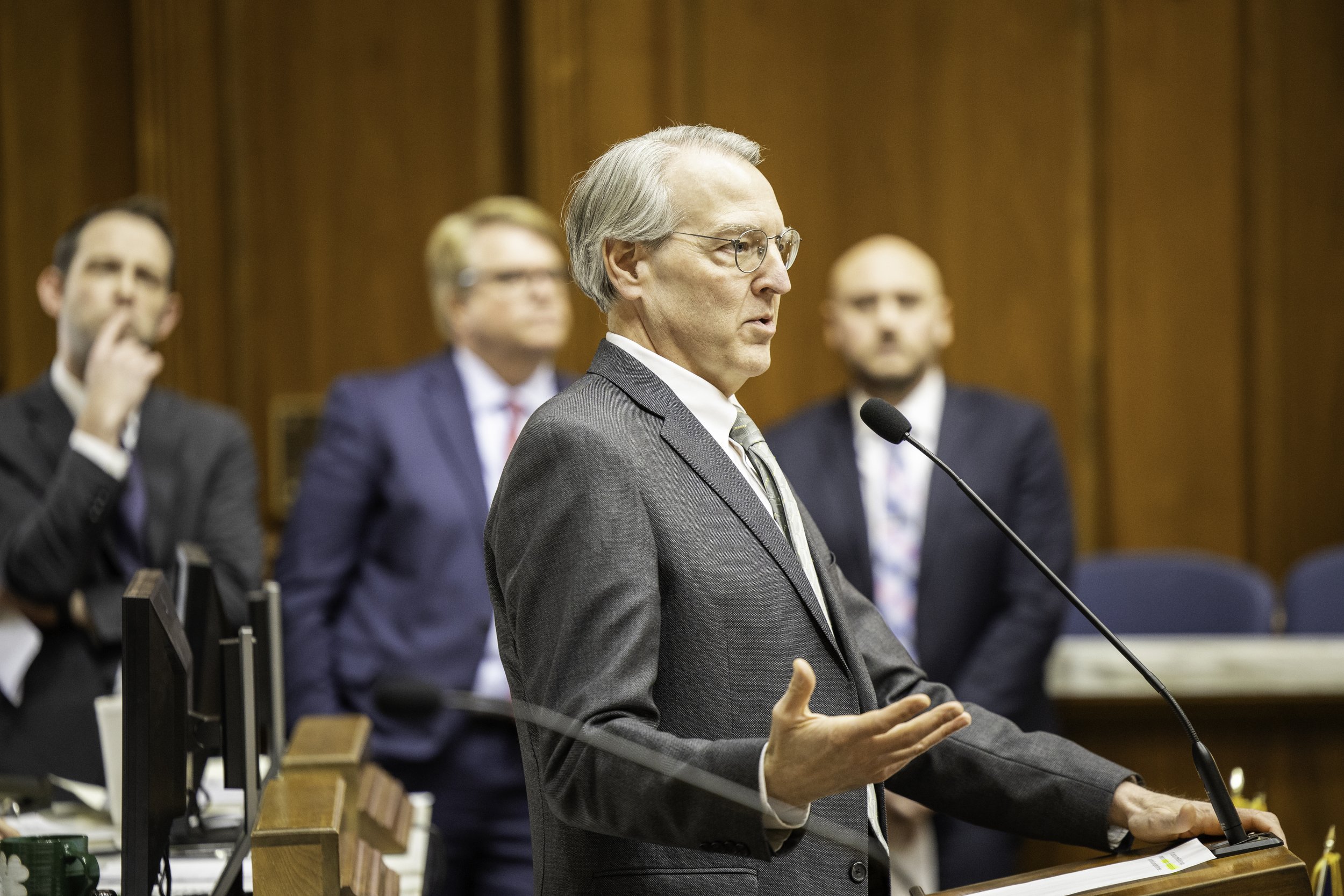
House Republicans reject Pierce amendment to protect Hoosiers from higher utility costs
Today, Feb. 10, State Rep. Matt Pierce (D-Bloomington) offered amendments to House Bill 1007 that would have prevented utility customers from bearing the cost of failed nuclear power plant projects
Today, Feb. 10, State Rep. Matt Pierce (D-Bloomington) offered amendments to House Bill 1007 that would have prevented utility customers from bearing the cost of failed nuclear power plant projects. The first amendment would have removed a provision in the bill that allows utilities to charge their customers for planning costs for Small Modular Reactors (SMRs) even when they decide to abandon the SMR project. The other amendment would have prevented utilities from charging their customers for SMRs that are not yet generating any electricity. An existing "Construction Work in Progress" (CWIP) law allows utilities to charge customers during the construction of an SMR, including cost overruns, before the SMR provides any benefit to utility customers. No SMR project has been completed in the United States. The most recent SMR attempt was abandoned in Utah after estimated project costs ballooned from around $3 billion to $9.3 billion.
Pierce released the following statement on his amendments:
"HB 1007 allows utilities to gamble on expensive, unproven technology with utility customers' money. It shifts the risk of speculative projects from Utility corporations onto the backs of utility ratepayers. If HB 1007 becomes law, it will give a green light for utilities to pursue one of the most expensive forms of energy that will take years to build. I fear customers will be saddled with higher rates to pay for a boondoggle.
"Once again, the House of Representatives missed an opportunity to protect utility customers from higher rates."