

Latest News
Find our archive of news distributions below. To request a media interview or statement from one of our members, visit our press inquiries page here.
Search Our Press Release Archive
Sort by Rep. or Topic
- Economy
- Education
- IBLC
- Internship
- Leadership
- Mental Health
- Public Safety
- Rep. Alex Burton
- Rep. Blake Johnson
- Rep. Carey Hamilton
- Rep. Carolyn Jackson
- Rep. Cherrish Pryor
- Rep. Chris Campbell
- Rep. Chuck Moseley
- Rep. Dant Chesser
- Rep. Earl Harris Jr.
- Rep. Ed DeLaney
- Rep. Gregory W. Porter
- Rep. John Bartlett
- Rep. Justin Moed
- Rep. Kyle Miller
- Rep. Matt Pierce
- Rep. Maureen Bauer
- Rep. Mike Andrade
- Rep. Mitch Gore
- Rep. Pat Boy
- Rep. Phil GiaQuinta
- Rep. Ragen Hatcher
- Rep. Randy Novak
- Rep. Renee Pack
- Rep. Robin Shackleford
- Rep. Ryan Dvorak
- Rep. Sheila Klinker
- Rep. Sue Errington
- Rep. Tonya Pfaff
- Rep. Vanessa Summers
- Rep. Vernon Smith
- Rep. Victoria Garcia Wilburn
- Rep. Wendy Dant Chesser
- cherrish

OP-ED: No, you're not hallucinating – AES wants to raise your rates again.
AES Indiana just requested to raise their rates on consumers. Again.
AES Indiana just requested to raise their rates on consumers. Again.
Last year, they raised rates for consumers by an average of $9.36 per month, although their original ask was $17.50. This year, they want an increase of 13.5%, but in reality is closer to 21% and will cost Hoosiers an extra $30 every month. If it feels like your utility bill is always growing, that’s because it is.
To some, $30 a month, or $360 dollars a year, may not seem like a lot. But what if your electricity bill rose $360 every year? In five years, you would see your bill grow by $1,800. Asking the IURC to approve a rate increase shouldn’t become an annual tradition for utility companies across the state, including AES, and those additional monthly costs add up quickly. When coupled with inflation, high housing costs, increased grocery costs, higher medical bills and lagging growth in wages, this rate increase very well could be the straw that breaks the camel's back for residents in Marion County. And those who are living paycheck to paycheck, or on a fixed income, may be forced to sacrifice essentials like food or medication to cover that extra $30 month after month.
In 2020, AES was approved to use $1.2 billion from ratepayers to upgrade their system. Ratepayers are still in the process of paying for that, as the plan built in seven years of consecutive increases on top of other requests they have made separately. By the time the 21% hike would go into effect, you would really see an increase of 27% because of a 6% increase already approved to cover projects such as the Pike County battery storage facility.
It's honestly hard to keep track of how many times AES has raised their rates. Over the last decade, rates have increased by more than 34%. The pace at which prices are increasing is not sustainable for Hoosier families. Something eventually must give. In 2024, I filed an amendment to create a one-year moratorium on rate increases to help Hoosiers catch their breath. The Republican supermajority at the Statehouse struck this down.
Every time these rate hike requests are made, the justification has been a system or infrastructure improvement. However, even with the additional revenue, many pressing concerns about the services have gone unaddressed. After the increase in 2023 to “upgrade” systems, customers experienced issues such as charges on their account three times the normal size with no explanation, charges being withdrawn up to 10 times without immediate refund and completed payments being marked as missing. AES paused disconnections temporarily while they stabilized the billing system, but disconnections were recently resumed with many customers still facing billing issues.
Are consumers just supposed to helplessly accept that they must pay more and more for utilities every single year? Part of AES' justification for this most recent request was that they need to cover the cost of doing business due to inflation and rising costs. We all live in this economy. Hoosiers are facing the consequences of inflation and rising costs too. But the average person can’t demand money from others to cover our expenses. And because utilities are regulated monopolies, ratepayers don’t have a choice of providers. Which means, we are left footing the bill at the whim of stockholders who don’t have a connection to our communities.
If a $1.2 billion upgrade isn’t enough, and you have to ask for tens of millions of dollars every year and still not solve basic customer-service issues, how can any amount of money be enough? I was heartened to see Gov. Mike Braun express displeasure over this rate hike request. But ultimately, Gov. Braun and the last 20 years of Republican leadership are responsible for the high rates consumers find themselves paying today. If Gov. Braun wants to stand up for affordability, he should call on IURC to deny this outrageous request.

GiaQuinta, House Democrats condemn slashing of Indiana state pre-K program
As Hoosier parents prepare their household budgets for the 2025-2026 school year, fewer working families will have On My Way Pre-K, Indiana's state preschool program, at their disposal to assist with the cost of sending their 3- and 4-year-olds to pre-K. Gov. Braun's administration announced at the beginning of June that it would slash On My Way Pre-K seats from over 6,000 to 2,500 for the upcoming school year.
Additionally, reimbursement subsidies for families enrolled in the program will be capped at $147.82 a week – for some counties, this will slash reimbursement rates in half or more. This means that child care providers will receive less money from the state for children enrolled in the program, disincentivizing provider participation and broad access, and low-income families will be responsible for the cost not paid for by the state.
House Democratic Leader Phil GiaQuinta (D-Fort Wayne) and House Democrats are deeply concerned that the Braun administration and Statehouse Republicans chose to prioritize the expansion of Indiana's private school voucher program to millionaires and billionaires this session over maintaining the On My Way Pre-K program for low- to moderate-income families. GiaQuinta released the following statement reacting to the cuts.
As Hoosier parents prepare their household budgets for the 2025-2026 school year, fewer working families will have On My Way Pre-K, Indiana's state preschool program, at their disposal to assist with the cost of sending their 3- and 4-year-olds to pre-K. Gov. Braun's administration announced at the beginning of June that it would slash On My Way Pre-K seats from over 6,000 to 2,500 for the upcoming school year.
Additionally, reimbursement subsidies for families enrolled in the program will be capped at $147.82 a week – for some counties, this will slash reimbursement rates in half or more. This means that child care providers will receive less money from the state for children enrolled in the program, disincentivizing provider participation and broad access, and low-income families will be responsible for the cost not paid for by the state.
House Democratic Leader Phil GiaQuinta (D-Fort Wayne) and House Democrats are deeply concerned that the Braun administration and Statehouse Republicans chose to prioritize the expansion of Indiana's private school voucher program to millionaires and billionaires this session over maintaining the On My Way Pre-K program for low- to moderate-income families. GiaQuinta released the following statement reacting to the cuts:
"Working parents are already stretched thin. Now, they’re being told to do more with less – the theme of this administration. Cutting On My Way Pre-K means pulling the rug out from under hard-working families who were planning to use this program to make their household budget work.
"These cuts weren't inevitable. In the 2025 budget, Statehouse Republicans chose to prioritize making private school vouchers universal. While millionaires and billionaires are getting more tuition assistance for the private schools their children already attend, working families are being told that pre-K for their 3- and 4-year-olds is too expensive for the state. That’s not budgeting — that’s bad priorities. Amid a budget shortfall, Statehouse Republicans found the money to expand a program that they cared about. It just wasn't the program that benefits families struggling to get by.
"Hoosier families deserve more, plain and simple."

Jackson comments on FSSA slashing On My Way Pre-K
The Family and Social Services Administration (FSSA) recently announced several significant cuts to On My Way Pre-K. These cuts include capping enrollment at 2,500 children, down from over 6,000 enrollees last year, and slashing the provider reimbursement rates.
The Family and Social Services Administration (FSSA) recently announced several significant cuts to On My Way Pre-K. These cuts include capping enrollment at 2,500 children, down from over 6,000 enrollees last year, and slashing the provider reimbursement rates.
In the 2025 state budget, FSSA faced the 5% budget cut that most state agencies did and were recently ordered to cut an additional 5% specifically from their personnel and technology budgets. The agency claims that the cuts to the On My Way Pre-K program are a result of the budget reduction.
State Rep. Carolyn Jackson (D-Hammond) issued the following statement:
“I am extremely concerned about the recent cuts to On My Way Pre-K and the devastating impacts they will have on our state and our community. Over 85% of 4-year-olds in Indiana do not have access to preschool. On My Way Pre-K is already an extremely limited program to help the most vulnerable afford to send their children to pre-K. Now, 3,500 fewer Hoosier children will likely not be able to enroll in pre-K because their families cannot afford it without the voucher.
"Additionally, the financial incentive for providers to accept On My Way Pre-K vouchers in Lake County was reduced by up to 46%. Many facilities may choose or be forced to no longer participate in the program. Every year, I have families reaching out to me for help getting their children into pre-K because of the limited class sizes and long waitlists. Reducing this incentive will reduce class sizes even more. Families who desperately want to give their child a leg up with early childhood education are being left high and dry.
“Indiana is one of only six states in the entire country that doesn’t fund a universal pre-K system. Early childhood education has been proven to improve academic performance and even salaries later in life. Additionally, access to pre-K boosts our economy by allowing parents to return to the workforce. The state should be pouring resources into expanding pre-K access for all children, not cutting it for vulnerable populations. If pre-K is a luxury that only wealthy families in well-off suburbs can afford, children living in underserved communities will be hurt the most.
“Republican leadership claims that they had to cut funding for FSSA because there simply wasn’t enough money. I would like to know how they found $1.2 billion to expand private school vouchers universally so millionaires and billionaires can use taxpayer dollars to send their kids to private school. This is not about fiscal responsibility. This does not help working Hoosiers. This policy is harmful for children, families and our economy.”

Johnson announces winner of 2025 Mary Moriarty Adams Memorial Scholarship
State Rep. Blake Johnson (D-Indianapolis) has announced that the Mary Moriarty Adams Memorial Scholarship committee has selected a recipient for 2025. The winner is Mariah Questelles of Purdue Polytechnic High School Englewood. Mariah will attend Indiana University in the fall with plans to study neuroscience and pursue a pre-med track.
State Rep. Blake Johnson (D-Indianapolis) has announced that the Mary Moriarty Adams Memorial Scholarship committee has selected a recipient for 2025. The winner is Mariah Questelles of Purdue Polytechnic High School Englewood. Mariah will attend Indiana University in the fall with plans to study neuroscience and pursue a pre-med track.
The Mary Moriarty Adams Memorial Scholarship is granted to a high school student in House District 100 who demonstrates their commitment to community and public service. The one-time, $5,000 scholarship is awarded each year by Johnson and his wife, Natalie. It was created and named in honor of former Indianapolis City-County Councilor and dedicated public servant, Mary Moriarty Adams, who passed away in 2018.
“Natalie and I are thrilled to award the 2025 Mary Moriarty Adams Memorial Scholarship to Mariah Questelles. Mariah represents the very best of our city’s future—smart, driven, and deeply committed to serving others. Her leadership at school and in the community has been inspiring, and we’re proud to support her as she pursues her dream of becoming a doctor.”
“The selection committee was thrilled by the number of impressive applicants this year. It’s a powerful reminder that so many young people are stepping up to make a difference in Indianapolis. This scholarship is one small way we can celebrate that commitment to service and invest in the next generation of leaders—leaders like Mariah.”

OP-ED: GOP’s Medicaid & SNAP Cuts Will Hit Indiana Hard: “Local taxpayers will bear the weight of federal abandonment.”
Op-Ed: GOP’s Medicaid & SNAP Cuts Will Hit Indiana Hard: “Local taxpayers will bear the weight of federal abandonment.”
By: State Rep. Robin Shackleford (D-Indianapolis)
Word Count: 825
By: State Rep. Robin Shackleford (D-Indianapolis)
Word Count: 825
When Congress plays politics with essential programs like Medicaid and SNAP, it’s not D.C. that pays the price - it’s us. It’s Indiana. As a state lawmaker who hears daily from working families, single parents and seniors trying to make ends meet, I can tell you exactly what Republicans’ so-called “big, beautiful” bill would mean for Indiana: higher burdens, fewer safety nets and deeper struggles for our most vulnerable neighbors.
This bill, passed with thin margins out of the U.S. House of Representatives and cheered on by the president, is being framed as a solution to government-spending overreach. But let’s be clear: Gutting Medicaid and slashing access to food assistance isn’t reform. It’s abandonment of the people who need help the most.
Changes to Supplement Nutrition Assistance Program (SNAP) alone would result in the loss of more than 100 million meals for Hoosier families over the next decade. In Indiana, more than 2 million people rely on Medicaid, including children, seniors, and people with disabilities. Over 600,000 Hoosiers depend on SNAP to keep food on the table. Under this bill, tens of thousands could lose that support overnight.
Who picks up the slack when families fall through the cracks? State governments. If Washington cuts Medicaid funding, Indiana will be forced to either slash services – on top of what was already cut during this past legislative session – or absorb the costs. And we all know those costs don’t disappear.
The cost shift to Indiana from federal cuts to programs like SNAP could be as high as $356 million over the next 10 years – and that figure only reflects SNAP. When federal support for essential programs is reduced, the ripple effects are widespread. That’s money the state will need to find not just to keep kids fed during school breaks, but also to prevent seniors from losing health coverage, to help working parents afford basic child care, and to maintain support systems for low-income families. If Indiana can’t –or doesn’t– fill the gap, the burden will fall to already overstretched local hospitals, food banks and community organizations. Emergency rooms will become overcrowded, untreated illnesses will spread and local governments will be forced to scramble for solutions. Ultimately, it’s local taxpayers who will bear the cost of federal disinvestment.
The federal legislation also introduces new work requirements for both Medicaid and SNAP recipients, mandating at least 80 hours per month of employment, education or community services for able-bodied adults without dependents. These requirements are set to begin in 2026 and apply to individuals aged 19 to 64. Exemptions are limited to individuals under 19, pregnant women or those who are caring for a young child or person with disabilities.
Additionally, Medicaid recipients will need to verify eligibility twice a year instead of once – which is less stringent than the recently passed Senate Enrolled Act 2 in Indiana that already imposes quarterly, monthly and yearly eligibility checks.
The bill also raises the age limit for SNAP work requirements from 54 to 64, meaning older adults would now be required to meet work conditions or risk losing their benefits.
For many seniors already facing health issues or barriers to employment, this is not realistic. According to the Congressional Budget Office, the bill would slash Medicaid funding by over $700 billion, and Indiana could see an decrease of an estimated $15 billion in federal Medicaid funding.
We’ve seen this playbook before: shift the burden downward, call it “efficiency” and leave working families behind. These policies don’t just cut, they punish. They stigmatize poverty and make it harder for Hoosiers to access help when they need it most. And they ignore the real barriers many people face: lack of transportation, unpredictable child care, nonexistent livable wages or unstable housing, all of which make meeting rigid new requirements nearly impossible.
I’ve spoken with families in our district who are already facing financial struggles. For them, SNAP and Medicaid aren’t handouts – they’re the difference between stability and crisis. Stripping those supports won’t make people more self-sufficient. It will push them further into hardship.
State leaders should be sounding the alarm, not quietly absorbing the damage. We should be pushing back, demanding that Congress strengthen safety nets, not unravel them. We should invest in long-term solutions that empower families, grow our economy and reduce the need for emergency relief, not policies that punish people for needing help in the first place.
And here's the truth policymakers don’t say out loud: this is all about the money. But if that’s the case, we should be honest – investing in people now is the cost-saving solution. When families have access to livable wages, reliable transportation, healthy food, quality health care and stable housing, they’re more likely to thrive. That means fewer emergency room visits, fewer evictions and fewer public dollars spent on crisis response later.
Hoosiers are resilient. But resilience isn’t a substitute for support. And when Washington chooses cuts over care, it’s Indiana that pays the price.
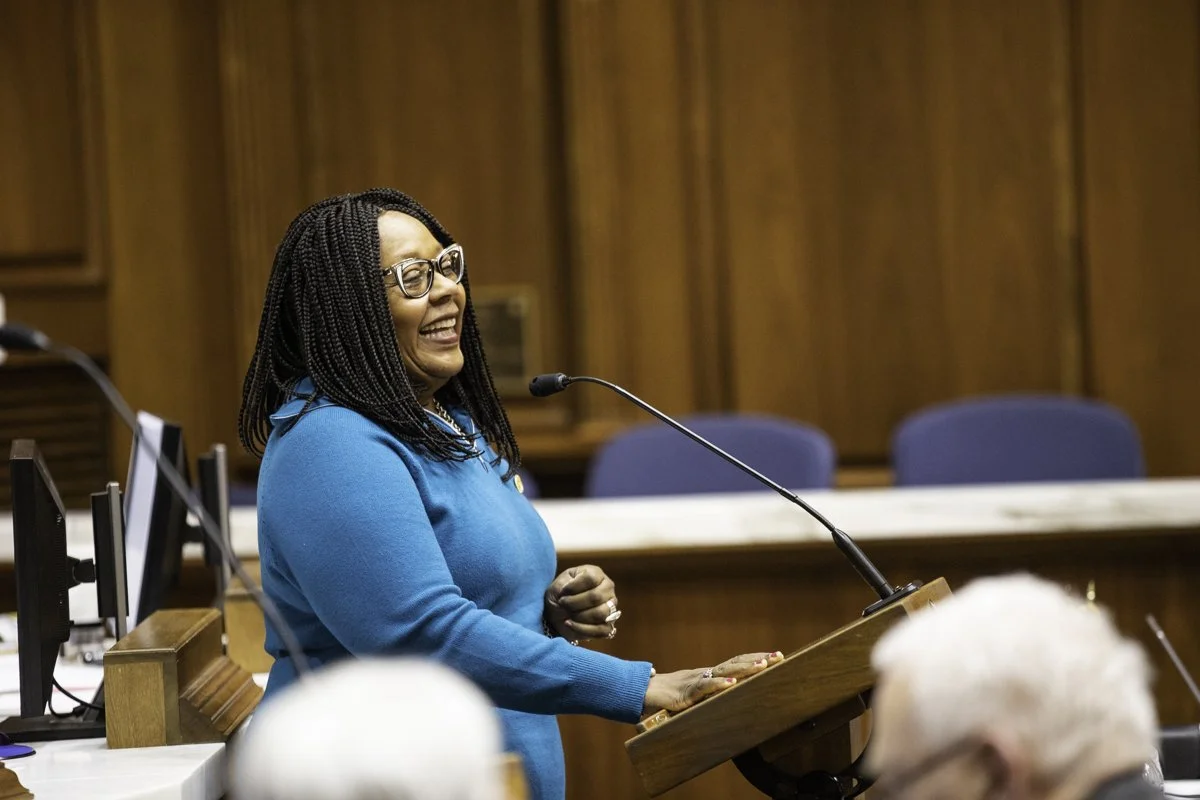
Jackson appointed to Council on State Governments’ Midwestern Legislative Conference Energy and Environment Committee
State Rep. Carolyn Jackson (D-Hammond) has been appointed to the Council on State Governments’ Midwestern Legislative Conference Energy and Environment Committee for 2025 and 2026.
State Rep. Carolyn Jackson (D-Hammond) has been appointed to the Council on State Governments’ Midwestern Legislative Conference Energy and Environment Committee for 2025 and 2026. The purpose of this committee is to connect legislators across the Midwest with each other and industry experts to inform policymaking for the future. Jackson currently serves on the Environmental Affairs Committee and the Natural Resources Committee in the Indiana House of Representatives.
“I am both honored and excited to have been appointed to the Committee on Energy and Environment for the Midwestern Legislative Conference of the Council on State Governments,” Jackson said. “Since I became a legislator, I have focused on promoting the health and well-being of my constituents while protecting the community from harmful substances like lead and other pollutants. I am proud to have created programs to test schools and child care facilities for lead in drinking water, which can cause developmental disabilities in children. Additionally, I have worked to find solutions to make energy in Indiana more affordable and more efficient.
“I look forward to the opportunity to collaborate and learn from other legislators and policy experts from across the nation. Environmental policy is unique in the sense that the policies of one state impact neighboring states. In order to effectively govern, state governments must communicate and work together. This opportunity gives Northwest Indiana a seat at the table, and I am excited to advocate for Hoosiers and bring what I learn back to the General Assembly.”

GiaQuinta comments on Braun IU trustee removals and appointments: ‘Promises made, promises broken’
Yesterday, June 2, Gov. Mike Braun removed three elected members of the Indiana University Board of Trustees by way of authority granted to him by the General Assembly in a last-minute, unvetted move to end alumni trustee elections at Indiana University. In their places, he appointed James Bopp, Jr., a prominent conservative attorney known for his work to overturn Roe v. Wade; Sage Steele, a conservative sports broadcaster; and Brian Eagle, an Indianapolis attorney. Braun previously indicated that he would not immediately take action to use this new unilateral authority of the governor over IU.
House Democratic Leader Phil GiaQuinta (D-Fort Wayne), an IU graduate himself, released the following statement.
Yesterday, June 2, Gov. Mike Braun removed three elected members of the Indiana University Board of Trustees by way of authority granted to him by the General Assembly in a last-minute, unvetted move to end alumni trustee elections at Indiana University. In their places, he appointed James Bopp, Jr., a prominent conservative attorney known for his work to overturn Roe v. Wade; Sage Steele, a conservative sports broadcaster; and Brian Eagle, an Indianapolis attorney. Braun previously indicated that he would not immediately take action to use this new unilateral authority of the governor over IU.
House Democratic Leader Phil GiaQuinta (D-Fort Wayne), an IU graduate himself, released the following statement:
"I am incredibly disappointed in this decision by Gov. Braun to remove democratically elected IU trustees for a number of reasons.
"Not fulfilling a promise you previously made is par for the course with this administration – first property tax relief, now IU trustee appointments. Promises made, promises broken.
"IU leads the world in its rigor and research breakthroughs because its experts have been allowed to operate within the realm of academic freedom. It's not hard to imagine that our two new trustees who are well known for their successful work overturning a woman's right to choose and work in the conservative media circuit, respectively, will have an agenda to limit the research questions that researchers and professors are allowed to pose. This, combined with recent Statehouse Republican actions to threaten tenure and degree programs, will limit the number of world-class researchers willing to relocate to Indiana. Why take a risk on a university system with less academic freedom protections?
"Gov. Braun stated that this decision will 'help guide IU back in the right direction.' Republican governors of Indiana have been appointing the majority of the IU Board of Trustees for 20 years now. If the university has been headed in the wrong direction, the Indiana Republican Party objectively bears some responsibility for that.
"Finally, this decision doesn't just affect the university – it also hurts working Hoosiers. In particular, IU's strong life sciences programs have helped Indiana's life science, biotechnology and pharmaceutical industries flourish. When we start making workforce pipeline decisions about politics instead of business, I worry that the companies that employ thousands of Hoosiers with good-paying jobs will suffer and ultimately disinvest in our state."

Pryor reminds community of upcoming National Gun Violence Awareness Weekend
Friday, June 6, is National Gun Violence Awareness Day, marking the beginning of Wear Orange weekend.
Friday, June 6, is National Gun Violence Awareness Day, marking the beginning of Wear Orange weekend. State Rep. Cherrish Pryor (D-Indianapolis) is reminding the community to wear orange this weekend to honor those who have been impacted by gun violence and advocate for action against gun violence. This movement is put on by the group Everytown for Gun Safety and brings people together from across the nation to advocate for gun reform.
“Far too many people in our community have had their lives torn apart by gun violence,” Pryor said. “Just earlier this month, 14 people were injured and a 17-year-old was killed in a single weekend in Indianapolis. Black and brown communities are disproportionately affected by gun violence, and it is the leading cause of death for children in our nation.
“Our city should be a place where people can thrive, not constantly worry about surviving. That is why I am calling on our community to come together for Wear Orange weekend to honor those who have fallen victim to gun violence. Indiana has some of the loosest gun safety policies in the nation, and we all pay the price. It is time to demand a change.
"Join me by wearing orange on Friday, June 6, to kick off the weekend. I encourage all those who are able to be part of that change by participating in Wear Orange weekend."
For more information and to find/register for an event, click the link here.

Andrade honors EMS Veteran George Schulp for fourty years of service
Today, May 22, State Rep. Mike Andrade (D-Munster) joined EMS professionals, local leaders and colleagues to honor George J. Schulp, a retiring emergency medical professional whose career spanned more than 40 years of service, education and advocacy in Indiana’s EMS system.
Today, May 22, State Rep. Mike Andrade (D-Munster) joined EMS professionals, local leaders and colleagues in Highland to honor George J. Schulp, a retiring emergency medical professional whose career spanned more than 40 years of service, education and advocacy in Indiana’s EMS system.
The ceremony, held at the Superior Ambulance Highland Station, coincided with National EMS Week (May 18–24), a national observance recognizing the life-saving contributions of EMS providers across the country.
Schulp was recognized for his decades of frontline work as an EMT and paramedic, as well as his leadership as an instructor and EMS training center operator. Throughout his career, he trained and mentored countless first responders, helping to build a stronger, more prepared EMS workforce across Indiana.
He also served in key leadership roles with the Indiana EMS Association, including as vice president, and played an instrumental role in launching the Indiana EMS license plate — an initiative that provides funding for EMS education and the Indiana EMS Memorial. His involvement in the EMS Education Workgroup helped shape statewide policy and curriculum improvements.
Andrade released the following statement following the ceremony:
“George’s legacy is written into the very foundation of Indiana’s EMS system. He responded to emergencies with courage, trained generations of first responders with care and fought to advance the profession at every level. It was my honor to recognize his service and celebrate the lasting impact he’s made on public safety in our state.”
A joint proclamation from Andrade and State Sen. Dan Dernulc formally recognized Schulp’s exceptional leadership and unwavering dedication to emergency medical services.
Schulp’s retirement marks the close of a remarkable chapter in Indiana’s EMS history, and the beginning of a legacy that will continue through the professionals he taught, mentored and inspired.

Pryor receives IUI O’Neill School Distinguished Alumni Award
On Monday, May 12, State Rep. Cherrish Pryor (D-Indianapolis) was presented with the 2025 Indiana University Indianapolis O’Neill School of Public and Environmental Affairs Distinguished Alumni Award.
On Monday, May 12, State Rep. Cherrish Pryor (D-Indianapolis) was presented with the 2025 Indiana University Indianapolis O’Neill School of Public and Environmental Affairs Distinguished Alumni Award. This is the highest honor bestowed by the school and honors those who have not only distinguished themselves in their fields but also set an example of what it means to live a life of service. Pryor earned a Master’s Degree in Public Affairs from the O’Neill School in 2005.
“I am truly humbled to receive this year’s Distinguished Alumni Award from the IU Indianapolis O’Neill School. My time at the O’Neill School of Public and Environmental Affairs laid the foundation for my career of speaking up for the voiceless and serving my community. While I had the value of service instilled in me growing up, my education and this institution gave me the skills and opportunities I needed to succeed in making a difference.
“While it was incredibly meaningful to be honored at Monday’s ceremony, I am also glad I had the opportunity to speak to the graduating class of 2025. My call to action to all the graduates in that room was to SERVE: Support others who are in need; Engage with those who share your vision to help those less fortunate; Reward those who make sacrifices so that others can reach their potential; Value the contributions of those working alongside you; Encourage those who may feel lost or are tempted to give up.
“Today, I am as proud as ever to be an alumni of the O’Neill School. I look forward to seeing all the wonderful achievements of the class of 2025!”
Pryor was nominated for the award by her college friend Robbin Grimes Sally.

Porter calls for study of BMV data sales to protect Hoosiers’ privacy
Yesterday, May 5, State Rep. Gregory W. Porter (D-Indianapolis) signed onto a letter calling for the legislature to study data sales by the Bureau of Motor Vehicles (BMV). Each year, the BMV generates millions in revenue by selling Hoosiers’ personal information–individuals' date of birth, name, address, license plate number and more. Porter has authored legislation for the past two years that allows Hoosiers to opt out of data sales and protects seniors and teens.
Yesterday, May 5, State Rep. Gregory W. Porter (D-Indianapolis) signed onto a letter calling for the legislature to study data sales by the Bureau of Motor Vehicles (BMV). Each year, the BMV generates millions in revenue by selling Hoosiers’ personal information–individuals' date of birth, name, address, license plate number and more. Porter has authored legislation for the past two years that allows Hoosiers to opt out of data sales and protects seniors and teens.
“Not only is the BMV legally selling people’s information, but Hoosiers don’t get a say in the matter. I’ve authored legislation for the past two years that allows individuals to opt out of data sales. But the bill has never received a hearing. We’re chipping away at the issue, and we’ve had some successes. Derived from my initial legislation, the BMV must make annual reports on the fees it charges and the revenue generated from data sales. We still need to tackle the issue as a whole.
“Nobody should have their personal information sold without their consent. Most Hoosiers don’t even know their data is being sold to third parties. They sell it to towing companies, insurance agencies, debt collectors, auto dealers and more. We have no clue what these third parties do with the information after purchasing it.
“Hoosiers value personal privacy. Now is the time to study this topic, so we can act next year.”

Pryor denounces Lt. Gov. Beckwith’s embrace for the 3/5 Compromise, Attack on Indianapolis Faith Leaders
Last week, Lt. Gov. Micah Beckwith shared a video to his social media pages including incorrect information on the 3/5 Compromise following a member of the Indiana Black Legislative Caucus (IBLC) mentioning the political move on the Senate floor. Beckwith praised the 3/5 Compromise as a tool used by the North in the Civil War to eradicate slavery.
Last week, Lt. Gov. Micah Beckwith shared a video to his social media pages including incorrect information on the 3/5 Compromise following a member of the Indiana Black Legislative Caucus (IBLC) mentioning the political move on the Senate floor. Beckwith praised the 3/5 Compromise as a tool used by the North in the Civil War to eradicate slavery.
State Rep. Cherrish Pryor (D-Indianapolis) issued the following statement in response:
“The 3/5 Compromise was used to legitimize slavery and justify the mistreatment of Black Americans, as is proven by the Fugitive Slave Clause, the 1857 Dred Scott U.S. Supreme Court decision that ruled Blacks were not citizens, selling slaves, raping slave women and so much more. It was not a ‘great move’ by the North to eradicate slavery. It was 78 years from the US Constitution signing to the Thirteenth Amendment ratification, which made slavery illegal. The best, humane and Christian option was to ban slavery…not embrace it as a 'great move.'
"Impacts from slavery are still felt today in our courts, neighborhoods, doctor’s offices, jobs and ballot boxes. For someone to celebrate it, especially someone in a position of power, is deeply troubling.
“To make matters worse, the Lt. Governor's response has been to attack 'inner city' clergy for speaking against his embrace of the constitutional provisions that treated Blacks as property. This attack on inner city clergy, who are Democrats and Republican, is not grounded in scripture, and is disheartening. These faith leaders are true public servants that advocate on behalf of the least of thee. From feeding the hungry, helping pay bills, providing childcare and helping resolve school challenges, clergy play a significant role in our communities and are responsible for helping to bring up the next generation of God-fearing leaders in Indiana.
“I pray that Lt. Gov. Beckwith will move to focus on making life better for Hoosiers, not dividing us. While this topic brings with it the weight of hundreds of years of oppression and suffering for Black Americans, I ask for us all to do the difficult thing and pray for those that embrace racism, ignorance, greed and power. It must be difficult to live with that much hate in your heart.”